
- Home
- About Counsel
- Tools Hub
- Practice Hubs
-
Guides & Blogs
SARFAESI Act ArticlesDRT & RBI Rules
- Case Evaluation
The Securitisation and Reconstruction of Financial Assets and Enforcement of Security Interest (SARFAESI) Act, 2002 represents one of the most potent legislative frameworks enacted by Parliament for debt recovery. While Section 13(2) and Section 13(4) grant secured creditors statutory powers to enforce mortgages without civil court intervention, Section 13-A establishes crucial statutory parameters surrounding financial assistance, advisory management, and procedural obligations of secured creditors and asset reconstruction companies.
However, no statutory provision enacted by Parliament operates in a constitutional vacuum. The exercise of extraordinary statutory powers by public sector banks and financial institutions under Section 13-A must strictly satisfy the constitutional test of Article 14 of the Constitution of India, which guarantees equality before the law and equal protection of the laws.
Constitutional jurisprudence established by the Supreme Court of India in landmark decisions—including E.P. Royappa v. State of Tamil Nadu (1973) and Maneka Gandhi v. Union of India (1978)—transformed the interpretation of Article 14. Equality is not merely a formal formula; arbitrariness is antithetical to equality. Where an administrative action or statutory procedure is arbitrary, uncanalized, or devoid of reason, it violates Article 14 per se.
Under Section 14 of the SARFAESI Act, the Chief Metropolitan Magistrate (CMM) or District Magistrate (DM) assists secured creditors in taking physical possession of mortgaged assets. As settled by the Supreme Court in Standard Chartered Bank v. V. Noble Kumar (2013), Section 14 is a purely executive and administrative exercise—not a judicial one. The DM/CMM holds no jurisdiction to adjudicate title disputes or evaluate borrower defenses, and proceedings take place ex-parte at the back of the borrower and guarantor, who have no right of hearing before the Magistrate.
Because Section 14 operates without adversarial hearing, the 2013 Legislative Amendment inserted a mandatory provision requiring the Authorised Officer to file a solemn 9-point Affidavit verifying that all statutory preconditions (NPA declaration, 60-day Section 13(2) notice, receipt and disposal of Section 13(3A) objections, and accurate debt amounts) have been strictly satisfied.
When an Authorised Officer submits an incomplete, misleading, or false 9-point affidavit to obtain a Section 14 possession order—for instance, falsely declaring that Section 13(3A) objections were properly considered when they were mechanically rejected, or concealing that the land is agricultural under Section 31(i)—the legal consequences are devastating:
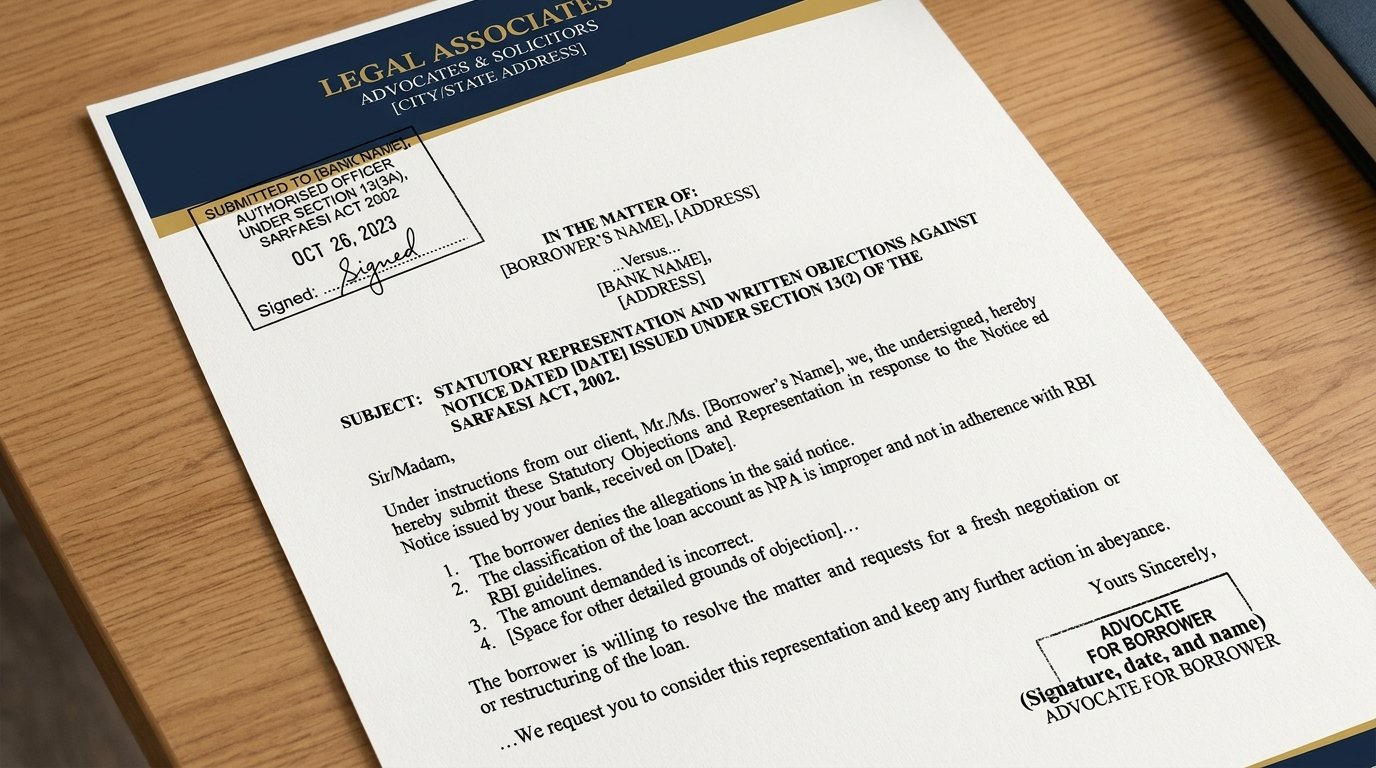
Figure 2: Formal Written Objections & Representation submitted by Borrower under Section 13(3A) SARFAESI Act challenging account classification and interest debits.
A frequent practical breach occurs when an Authorised Officer disposes of detailed statutory objections under Section 13(3A) using a mechanical formula: "The objections submitted by the borrower are not tenable, hence rejected."
Under the Supreme Court ruling in Mardia Chemicals (Para 45), applying one's mind and communicating reasons is a mandatory statutory precondition under Section 13(3A). A stereotype rejection renders the Section 13(3A) compliance void, thereby rendering all subsequent Section 13(4) measures and Section 14 DM orders illegal and void ab initio.
Full Judicial Citation: 1978 AIR 597, 1978 SCR (2) 621 | Decided On: 25 January 1978 | Bench: 7-Judge Constitution Bench
Relevant Paragraph: Para 56 & Para 85 (per Bhagwati, J.)
"Equality is a dynamic concept with many aspects and dimensions and it cannot be 'cribbed, cabined and confined' within traditional and doctrinaire limits. From a positivistic point of view, equality is antithetical to arbitrariness. In fact equality and arbitrariness are sworn enemies; one belongs to the rule of law in a republic while the other, to the whim and caprice of an absolute monarch. Where an act is arbitrary it is implicit in it that it is unequal both according to political logic and constitutional law and is therefore violative of Art. 14."
Official Source Link: https://indiankanoon.org/doc/1766147/
Full Judicial Citation: 1974 AIR 555, 1974 SCR (2) 348 | Decided On: 23 November 1973 | Bench: 5-Judge Constitution Bench
Relevant Paragraph: Para 85 (per Bhagwati, J.)
"The basic principle which informs Art. 14 is fairness in State action and any action taken by the State or its officers which is arbitrary and devoid of reason must be held to be unconstitutional and void... Non-arbitrariness is an essential facet of Article 14."
Official Source Link: https://indiankanoon.org/doc/1327287/
Full Judicial Citation: (2004) 4 SCC 311, AIR 2004 SC 2371 | Decided On: 8 April 2004 | Bench: Supreme Court of India
Relevant Paragraph: Para 45 & Para 80
"The reason to be communicated for not accepting the objections raised by the borrower would be necessary to be communicated to the borrower... The secured creditor must apply its mind to the representation or objection made by the borrower and if the same is not acceptable, communicate the reasons for non-acceptance to the borrower. This requirement is mandatory and safeguards Article 14 fairness."
Official Source Link: https://indiankanoon.org/doc/1059476/
Full Judicial Citation: (2014) 6 SCC 1, AIR 2014 SC 3712 | Decided On: 3 April 2014 | Bench: Supreme Court of India
Relevant Paragraph: Para 21 & Para 28
"The Authorised Officer of the secured creditor cannot dispossess a lawful tenant in possession of the secured asset without following the due process of law... Any high-handed eviction of lawful occupants by secured creditors without establishing lease determination before the Magistrate is illegal and unsustainable."
Official Source Link: https://indiankanoon.org/doc/182512683/
Full Judicial Citation: (2014) 5 SCC 610, AIR 2014 SC 1457 | Decided On: 10 February 2014 | Bench: Supreme Court of India
Relevant Paragraph: Para 34 & Para 53
"The secured creditor acts as a trustee of the mortgaged property... Any failure to strictly adhere to statutory 30-day notice provisions under Rule 8(6) and Rule 9(1) of the Security Interest (Enforcement) Rules, 2002 renders the auction sale void and makes the Authorised Officer personally answerable for breach of trust."
Official Source Link: https://indiankanoon.org/doc/171569502/
Full Judicial Citation: (2013) 9 SCC 620, 2013 STPL 7293 SC | Decided On: 22 August 2013 | Bench: Supreme Court of India
Relevant Paragraph: Para 26 & Para 28
"The satisfaction of the Magistrate under Section 14 is based solely on the affidavit filed by the Authorised Officer... Since Section 14 is an administrative exercise where borrowers are not heard, the affidavit carries absolute statutory responsibility, and any falsehood therein vitiates the order."
Official Source Link: https://indiankanoon.org/doc/812586/
Section 13-A governs statutory provisions relating to financial assistance, asset reconstruction advisory committees, and procedural parameters for secured creditors enforcing security interests under the SARFAESI framework.
Article 14 guarantees equality before the law and protection against arbitrary State action. Statutory discretion exercised by public sector banks under Section 13-A must satisfy the test of non-arbitrariness, procedural fairness, and reasonable classification.
In Mardia Chemicals Ltd. v. Union of India (2004) (Para 45 & 80), the Supreme Court held that extraordinary bank recovery powers under the SARFAESI Act must adhere to natural justice and Article 14 fairness.
Submitting a false or misleading 9-point affidavit under Section 14 constitutes perjury under IPC Section 193 / BNS Section 229 (up to 7 years imprisonment), strips the officer of Section 34 immunity, and renders the DM possession order void ab initio.
As held in Standard Chartered Bank v. V. Noble Kumar (Para 26), DM/CMM proceedings under Section 14 are non-judicial and executive in nature. Because borrowers have no right of hearing before the DM, the Authorised Officer's 9-point affidavit carries absolute statutory responsibility.
No. Section 34 immunity applies strictly to acts done in 'good faith'. Filing a false affidavit or committing fraud before a magistrate is mala fide, exposing the officer to direct criminal prosecution.
In Harshad Govardhan Sondagar v. International Assets Reconstruction Co. Ltd. (2014) 6 SCC 1 (Para 21 & 28), the Supreme Court held that an Authorised Officer cannot evict a lawful tenant without due process.
In Mathew Varghese v. M. Amritha Kumar (2014) 5 SCC 610 (Para 34 & 53), the Supreme Court held that failure to give 30-day notice under Rule 8(6)/9(1) renders the sale void, making officers answerable for breach of trust.
Yes. If an Authorised Officer takes physical possession through a false Section 14 affidavit or arbitrary rejection of objections, the entry is unlawful, attracting IPC Section 441/447 (Criminal Trespass).
This dossier is authored by Adv. Shakti Kumar Jain, B.Com, CAIIB, LL.B. (Gold Medalist), Founder & Lead Consulting Counsel at NPADoctor.com and retired Senior Officer from SBI SAM Branch with 35 years banking experience.
Procedural analysis of Section 13(2), 13(3A), 13(4), and Section 14 DM order stay petitions.
Read Full Sub-BlogDeep dive into statutory protection for agricultural land under Section 31(i) SARFAESI Act.
Read Full Sub-BlogConsult Adv. Shakti Kumar Jain's consultancy desk to evaluate Article 14 non-arbitrariness grounds and High Court writ options.
Submit Confidential Legal InquiryFor more detailed legal information, statutory analysis, and practice guidelines, please visit our comprehensive Practice Areas Directory .