⚠️ Content Protection: Inspecting elements is not permitted. This is a protected legal resource.

NPA Doctor

Financial Non Performing Asset Resolution

Strategic Legal Counsel for Banking NPAs, Bad Loans & Stressed Assets
NOT Medical Services | NOT Non-Practicing Allowance

High-Value Matters (₹5Cr+): 📞 83606-96178

Book Consultation Explore NPA Law

Curing Financial NPAs Since 2008

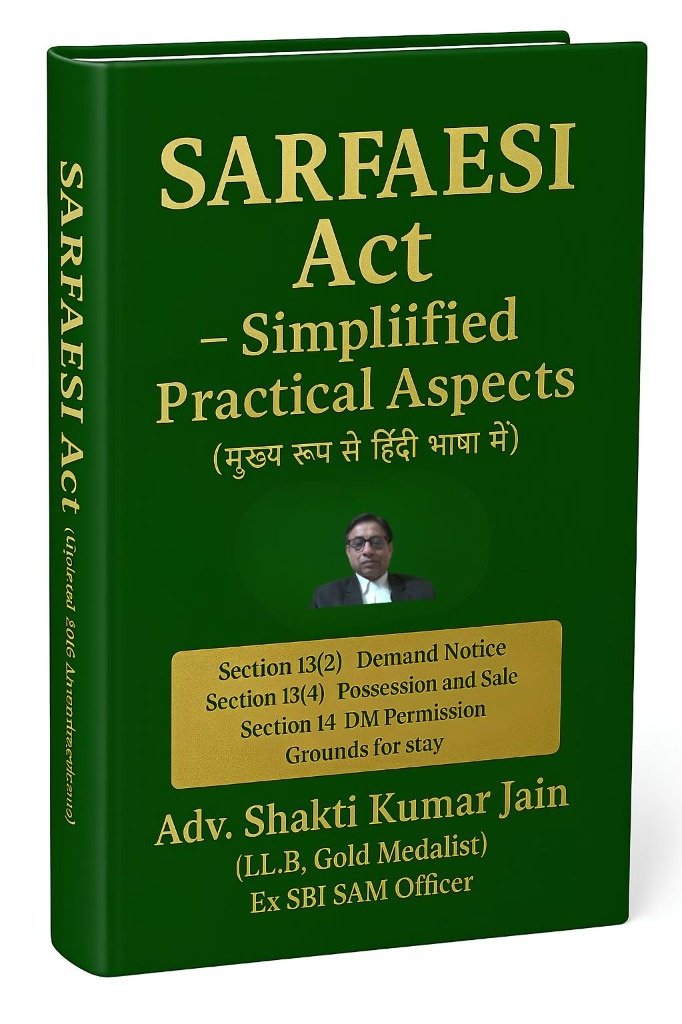
A Non Performing Asset (NPA) under RBI Master Circular DBOD.No.BP.BC.2/21.04.048/2014-15 is a loan account where interest or principal remains overdue for more than 90 days. Led by Adv. Shakti Kumar Jain (Ex-SBI Stressed Assets Management Officer, B.Com, CAIIB, LL.B Gold Medalist), we provide insider expertise on bank recovery mechanisms and borrower defense strategies.

Our Distinction: Unlike general practitioners, we combine banking operations expertise (CAIIB qualification + SBI SAM experience) with legal advocacy to provide solutions that address both the commercial and legal dimensions of distressed debt.

Financial NPA Resolution Centers

📊

NPA Account Analysis

Challenge wrongful IRAC classification. Defend SMA-0/1/2 categorization. Verify 90-day NPA norm compliance. Contest willful defaulter classification under RBI circulars.

🤝

OTS Strategy

One Time Settlement for >₹5Cr accounts. NPV-based calculations, Compromise Settlement Agreements, securing No Due Certificates, Board-level approval navigation.

🛡️

SARFAESI Defense

Challenge Section 13(2) notices, stop 13(4) possession, prevent auctions. 45-day DRT remedy protection. Agricultural land exemptions. Joint account nuances.

🏛️

DRT Chandigarh

DRT-1 (Punjab), DRT-2 (Haryana), DRT-3 (HP) jurisdiction. SA & OA filing strategies. DRAT appeals with pre-deposit. Recovery Certificate execution.

🏢

NCLT & IBC

CIRP defense, Section 7/9/10 petitions, Moratorium benefits, Resolution Plan formulation, Section 29A disqualification, Section 12A withdrawal.

⚖️

High Court Writs

Article 226/227 against arbitrary bank actions. Punjab & Haryana High Court jurisdiction. Constitutional remedies for fraud and natural justice violations.

Need Immediate Legal Intervention?

If you have received a Section 13(2) SARFAESI notice, DRT summons, or NCLT petition, strict limitation periods apply. Immediate consultation is advised.

📞 Urgent Consultation

Serious borrowers, guarantors, and auction bidders may seek personal appointment

NPA Classification & IRAC Norms

Critical: Wrongful NPA classification triggers premature recovery action. Understanding Income Recognition and Asset Classification (IRAC) norms is the first line of defense for high-value accounts.

RBI Master Circular Provisions

The Reserve Bank of India's Master Circular on Prudential Norms on Income Recognition, Asset Classification and Provisioning (DBOD.No.BP.BC.2/21.04.048/2014-15 dated July 1, 2014) mandates specific criteria for NPA classification.

What constitutes an NPA under RBI norms?
An account becomes NPA when interest or principal remains overdue for more than 90 days. For Cash Credit/Overdraft accounts, the account is "out of order" if:
  • The outstanding balance exceeds the sanctioned limit/drawing power continuously for 90 days; OR
  • There are no credits continuously for 90 days; OR
  • Credits are not enough to cover interest debited during the same period.
What are SMA categories and why do they matter?
Special Mention Accounts (SMA) are early warning signals:

SMA-0: 0-30 days overdue (early warning sign)
SMA-1: 31-60 days overdue (intensified monitoring required)
SMA-2: 61-90 days overdue (critical stage - immediate corrective action needed before automatic NPA classification)

Once SMA-2 status crosses 90 days, the account must be classified as NPA under RBI norms.

Willful Defaulter Classification

RBI Master Circular DBOD.No.CID.BC.22/20.16.003/2014-15 regulates "willful defaulter" classification, which carries severe consequences including debarment from institutional finance and directorships. This classification requires:

1
Identification Committee to examine default (minimum 3 officials)
2
Show Cause Notice to borrower/guarantor with 15 days to respond
3
Review Committee to confirm (higher authority than Identification Committee)
4
Reporting to RBI within 6 months of account becoming NPA

One Time Settlement (OTS) Strategy

Commercial Reality: OTS is not a statutory right but a commercial negotiation based on Net Present Value (NPV) of recoverable security. For accounts exceeding ₹5 crore, Board-level approval is mandatory under bank internal policies.

NPV Calculation Methodology

OTS offers are calculated based on the Net Present Value of the realizable value of security, factoring in:

  • Current market value of secured assets (not book value)
  • Time value of money (discounting future cash flows)
  • Estimated litigation costs and recovery timeline
  • Asset classification status (Substandard/Doubtful/Loss)
  • Promoter's track record and "skin in the game"
What makes an OTS legally binding?
An OTS is only binding upon execution of a Compromise Settlement Agreement accompanied by a comprehensive No Due Certificate (NDC) or Full and Final Settlement Letter. Critical elements:

• Explicit discharge from "all present and future claims"
• Return of original title deeds and securities
• Removal of name from CIBIL/CRILC as "settled"
• Specific mention of guarantor discharge
• Bank Board approval reference for high-value accounts
Can OTS be negotiated after SARFAESI possession?
Yes, though leverage diminishes. Banks may negotiate OTS even after Section 13(4) possession but before auction (Rule 8/9). Once auction notice under Rule 8 is published, settlement requires withdrawal of auction and lifting of possession, which requires higher administrative approval. Time is critical.

SARFAESI Act 2002 Defense Strategies

URGENT LIMITATION: The 45-day period for filing Section 17 application before DRT from the date of receipt of Section 13(2) notice is strictly enforced. Mardia Chemicals v. Union of India (2004) 4 SCC 705 upheld the constitutional validity of SARFAESI but mandated strict compliance with procedural safeguards.

Section 13(2) Notice Requirements

Before taking any measures under Section 13(4), the secured creditor must:

1
Issue 60-day demand notice under Section 13(2) calling upon borrower to discharge liabilities
2
Provide specific details of debt calculation and security intended to be enforced
3
Under Section 13(3A) (inserted 2004), reply to borrower representation within 15 days

Symbolic vs. Physical Possession

What is the difference between Rule 8 and Rule 9 possession?
Symbolic Possession (Rule 8): The Authorized Officer affixes notice on the property and publishes in newspapers. Borrower retains physical use, but title is clouded. Auction can be notified but physical delivery requires separate application.

Physical Possession (Rule 9): Actual dispossession of borrower. Requires Chief Metropolitan Magistrate (CMM) or District Magistrate (DM) assistance under Section 14 if there is resistance. For agricultural land, Section 31 exemptions may apply.
What properties are exempt from SARFAESI?
Under Section 31, agricultural land is exempt (though "agricultural" requires strict proof of current use). Additionally:
• Properties with less than 50 square meters and borrower income below ₹2 lakh/year (RBI circular protection)
• Properties under conciliation proceedings under Micro, Small and Medium Enterprises Act
• Properties under mortatorium in CIRP under IBC (overriding effect per Section 238 IBC)

DRT & DRAT Chandigarh Jurisdiction

Jurisdiction Mapping:
DRT-1 Chandigarh: Punjab State & Union Territory of Chandigarh
DRT-2 Chandigarh: Haryana State
DRT-3 Chandigarh: Himachal Pradesh
DRAT Chandigarh: Appellate jurisdiction for all three DRTs

Original Applications (OA) vs. Section 17 Applications (SA)

What is the difference between OA and SA?
OA (Original Application): Filed by Banks under Section 19 of RDDBFI Act, 1993 for recovery of debt. Limitation: 3 years from cause of action (Article 137 Limitation Act).

SA (Section 17 Application): Filed by Borrower/Guarantor under SARFAESI Act challenging measures under Section 13(4). Strict limitation: 45 days from date of possession/notice (extendable to 4 years 45 days if "sufficient cause" shown per L. Kumar v. Senior Regional Manager (2007) 5 SCC 738).

DRAT Pre-deposit Requirements

Can DRT entertain counter-claims?
Yes. The Salem Bar Association judgment directed DRTs to follow Civil Procedure Code principles where no specific provision exists. Borrowers can file counter-claims for damages due to illegal repossession, wrongful NPA classification, or excess interest charged, provided they are "connected with the debt" and not requiring extensive evidence that would delay recovery (per Mathew Varghese v. Mahajan (2019) 12 SCC 1).

DRT Execution Process

1
OA filed → Summons issued → Defendant files WS (30 days + 15 days extension)
2
Evidence by affidavit (Order XIII-A CPC as adapted)
3
Arguments → Recovery Certificate (RC) issued
4
Execution under Order 21 CPC: Attachment → Sale proclamation → Public auction

NCLT & Insolvency Resolution (IBC)

Paradigm Shift: IBC shifted from "Debtor-in-Possession" to "Creditor-in-Control." Once CIRP begins, Promoters lose control to Resolution Professional (RP). Innoventive Industries Ltd. v. ICICI Bank Ltd. (2018) 1 SCC 407 established that IBC has "overriding effect" over all other laws (Section 238).

Section 7 vs. Section 9 vs. Section 10

Who can initiate CIRP?
Section 7: Financial Creditor (Banks/NBFCs) - Default of ₹1 lakh+ (earlier ₹1 Cr, reduced temporarily)
Section 9: Operational Creditor (Suppliers/Employees) - Unpaid invoice ₹1 lakh+
Section 10: Corporate Applicant (Company itself/Directors) - Voluntary insolvency

Critical: For Section 7, the FC must prove "default" through records of Information Utility or other documentary proof. Mere claim is insufficient.

CIRP Timeline & Process

1
Admission order by NCLT (Day 0) - Moratorium commences
2
Appointment of IRP (Interim Resolution Professional) within 14 days
3
Public Announcement & Claim Collection (30 days)
4
CoC (Committee of Creditors) formation - FCs only (Section 21)
5
Resolution Plan submission (180 days + 90 days extension max) per Section 12
6
Liquidation if plan rejected or timeline expires
What is Section 29A disqualification?
Section 29A bars certain persons from submitting Resolution Plans:
• Undischarged insolvents
• Willful defaulters (per RBI)
• Persons with NPA accounts >1 year (connected persons)
• Convicted for 2+ years imprisonment (moral turpitude)
• Disqualified directors under Companies Act

Exception: MSME applicants have relaxed norms under 2018 amendments.

High Court Constitutional Remedies

When to Approach High Court vs. DRT/NCLT

Can I bypass DRT and go directly to High Court?
Generally, no. The principle of exhaustion of alternative remedies applies. However, exceptions exist:

1. Agricultural Land: If bank attempts SARFAESI on agricultural land (exempt under Section 31), High Court can intervene immediately.
2. Fraud: If the debt itself is fraudulent or forged, DRT has limited jurisdiction to adjudicate fraud (per S. S. M Engineering v. Indian Overseas Bank).
3. Natural Justice: Complete absence of notice under Section 13(2) SARFAESI.
4. Fundamental Rights: Where recovery action violates Right to Life (livelihood) under Article 21, especially for small borrowers.

Article 226 vs. Article 227

1
Article 226 (Writ Jurisdiction): Direct constitutional remedy against State action. Used for Certiorari (quashing orders), Prohibition (stopping proceedings), Mandamus (commanding action).
2
Article 227 (Supervisory Jurisdiction): High Court supervises subordinate courts/tribunals. Used to correct "grave illegality" or "jurisdictional error" by DRT/NCLT. Not an appeal but correction of records.
What is the "Mardia Chemicals" exception?
The Supreme Court in Mardia Chemicals carved out a limited exception for High Court intervention in SARFAESI matters where:
• The secured asset is residential property of the borrower (human right to shelter)
• The bank has violated Section 13(3A) (not replied to representation)
• The classification as NPA is prima facie fraudulent

However, the Court warned this is not a "roundabout way" to circumvent statutory remedies.
Strategic Note: High Court intervention is expensive and discretionary. It should be reserved for cases involving:
• Preservation of assets from imminent illegal auction
• Challenge to constitutional validity of circulars
• Protection of third-party bona fide purchasers
• Stay of coercive action where DRT would be rendered infructuous
Contact NPA Doctor →